 702-623-6362


 If you have been arrested, cited, charged, or even contacted by police in Las Vegas or elsewhere in Nevada, it is normal to feel overwhelmed. Many people do not know what happens next, what court will hear their case, whether they have to plead guilty right away, or how long the process can take.
The Nevada criminal process is not one single path that every case follows. Some matters begin with an investigation and never result in charges. Some cases end quickly through dismissal or negotiation. Others go through multiple hearings, motions, and a trial. The process can also differ depending on whether the case involves a misdemeanor, gross misdemeanor, or felony.
This guide explains what usually happens in a Nevada criminal case from the earliest investigation through possible post-conviction relief. It is designed to help you understand where your case may be headed, what each stage means, and when it makes sense to involve a criminal defense lawyer.
Timing is critical when you have been charged with a crime. What you do at the beginning of your case may determine how much money you will pay for bail; what charges will be filed against you; if there will be any plea bargains; if evidence can be suppressed; what kind of defense you use at trial; and if your record can be sealed after the fact.
On This Page
Many people do not need a generic legal article. They need to know what to do based on what is happening today. If that is you, start here:
This page gives the big picture. The linked pages go deeper into the specific stage of the case that affects you right now.
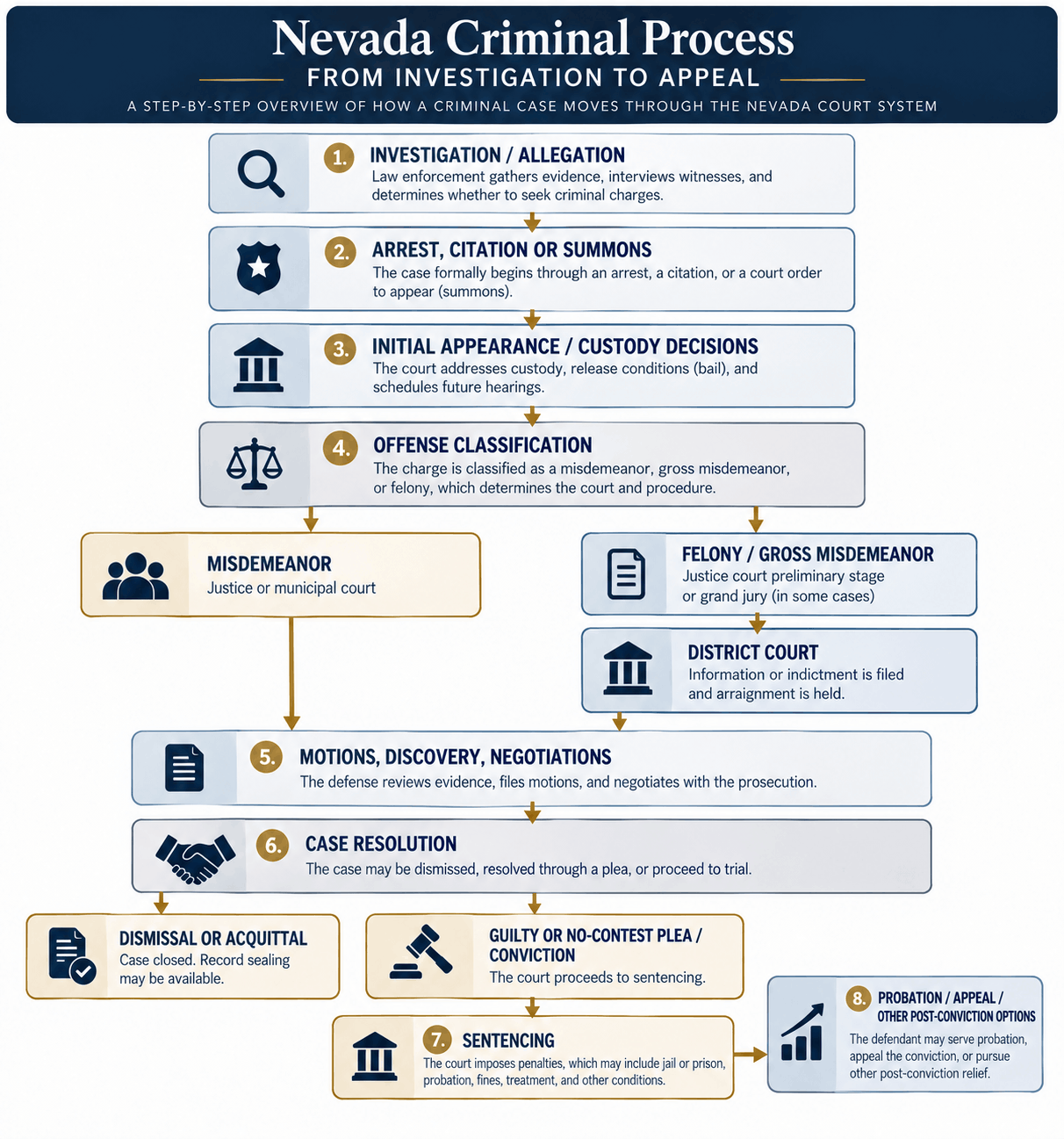
In general terms, most criminal cases in Nevada go through a process that looks something like this:
| Step | Description |
|---|---|
| Investigation | Police collect evidence, interview witnesses, look at reports and determine if they should file charges. |
| Arrest/Citation/Summons | A formal case starts when you are taken into custody, given a citation or ordered by the court to appear. |
| First Appearance/Release Issues | The court will address your custody status, any conditions for release and when your next court date will be. |
| Charging Review | Prosecutors will decide what charges to file and which court has jurisdiction over the case. |
| Preliminary Stage/Arraignment | The court will determine if there is enough evidence to support the charges filed against you; if so, the court will formally charge you; otherwise, the court will ask how you wish to plead. |
| Discovery/Motions | Defense attorneys will review all evidence and may make challenges to aspects of the prosecutor’s case. |
| Negotiation/Plea Discussions | Both sides will try to reach an agreement regarding how to resolve the case without going to trial. |
| Trial | If the case cannot be resolved through negotiation or plea bargaining, then a judge or jury will determine whether you are guilty or innocent. |
| Sentencing | After a conviction or plea, the court will impose a sentence. |
| Appeals/Post-Conviction Proceedings | You may appeal the decision made by the court or pursue other legal remedies. |
Not every case goes through every step. Some are dismissed very early. Others involve diversion, negotiations, or procedural motions that change the path completely.
 Which Nevada Court Will Handle Your Case?
One reason criminal procedure feels confusing is that different Nevada courts handle different types of criminal matters.
| Court | Typical role in the criminal process |
|---|---|
| Municipal Court | Usually handles city ordinance violations and certain misdemeanor matters within city limits |
| Justice Court | Commonly handles misdemeanors and the initial stages of gross misdemeanor and felony cases |
| District Court | Handles felony cases after bindover or indictment, as well as major motions, trials, and sentencing |
The type of charge matters too:
| Charge level | General path |
|---|---|
| Misdemeanor | Often remains in municipal or justice court |
| Gross misdemeanor | May begin in justice court and involve more formal procedures depending on the case |
| Felony | Usually begins with a complaint, arrest, or warrant and proceeds through preliminary hearing or grand jury process before district court |
Understanding which court is involved helps clarify what hearing is likely next and what options may be available.
A criminal case can begin long before anyone is arrested. In some cases, law enforcement investigates for days, weeks, or months before charges are filed. In others, an arrest occurs immediately at the scene.
Common starting points include:
At this stage, the police are trying to determine whether they believe a crime occurred and who they think committed it. Prosecutors may become involved before formal charges are filed, especially in more serious or document-heavy cases.
A critical mistake people make at this stage is assuming they can “clear things up” alone. Statements made during an investigation can become evidence. So can text messages, recorded calls, consent searches, and social media activity.
If you know you are being investigated, the case may still be in a phase where a defense lawyer can influence how it develops. That is why pre-file representation can matter.
For more on that phase, see our Pre-File Investigation page.
Not every criminal case begins with handcuffs. In Nevada, a person may be:
An arrest is just the start of the process. Once arrested, an individual can be brought to booking; they will have their photo taken; fingerprints will be collected; and they will be put into the system. The court will determine what type of release conditions exist and when future hearings will take place.
Many defendants are released very quickly. However, some defendants will continue to be held in custody as the court determines if there is sufficient evidence to grant bail; sets conditions of release; assesses public safety concerns; or reviews whether the defendant has violated previous release conditions.
This is typically the most confusing time for families who wish to receive immediate answers; however, the facts are continually being developed.
For more detailed practical guidance, see Las Vegas Arrests.
After arrest, one of the earliest concerns is whether the defendant will be released and under what conditions. This part of the process may involve bail, own-recognizance release, monitoring conditions, no-contact provisions, travel restrictions, or other limitations.
The initial appearance is significant as it can decide:
This is much more than just a scheduling issue. Early court appearances will provide an opportunity to establish leverage in the case. Early court appearances can also impact the defendant’s ability to participate in their own defense by impacting their employment, family obligations, travel and so forth.
If the allegations are weak, the defendant has strong ties to the community, and/or the charges do not warrant continued incarceration; then the defense can begin advocating immediately for more favorable release conditions.
A major weakness of many criminal-process pages is that they treat all cases the same. That is not how Nevada practice works.
Misdemeanor cases are often handled more quickly and remain in a lower court. The process may involve:
Misdemeanors generally have less severe penalties than felonies; therefore, the process is usually much faster. However, even though misdemeanors may be considered “lesser” offenses, they can still result in serious long-term effects on your life.
This includes but is not limited to: non-citizenship issues; professional license revocation/suspension; loss of parental rights during child custody battles; and/or having a criminal history.
Gross misdemeanor and felony cases are typically processed using more formal methods of charging and have much greater possible punishments. These types of cases may include:
In addition to the immediate sentence, felony cases can also result in long-term collateral consequences such as firearm restrictions, licensing issues, immigration consequences, registration requirements, and/or limitations on sealing your record in the future.
In more serious cases, the prosecution may need to establish probable cause before the matter proceeds further.
A preliminary hearing is not a trial. The judge is not deciding guilt or innocence. Instead, the issue is whether there is enough evidence for the case to move forward.
At this stage, the defense may gain useful information about:
Sometimes the hearing results in the case moving forward. Sometimes it exposes strategic weaknesses. In some situations, charges may be reduced, dismissed, or reshaped before the case advances.
In certain cases, the prosecution may proceed through a grand jury rather than a preliminary hearing. That route can lead to an indictment, which then places the case in district court.
The official charge(s) that are brought forward after either a preliminary hearing or a grand jury proceeding will determine how the case moves forward. This is important since those charges will be used to guide the rest of the case; such as at arraignment, in motion practice, during negotiations, for determining trial exposure and for assessing potential sentence risks.
Arraignment is often misunderstood. It is not a trial, and it is not always the dramatic moment people imagine from television.
At arraignment, the court generally addresses the charges and the defendant’s plea. In many cases, the options include:
Most defendants will enter a not-guilty plea at an early stage in their case to allow time for the defense team to investigate, review discovery and determine what options exist to resolve the case. The most important thing to remember is that an arraignment should not be viewed as a time to make a quick decision about entering a plea simply to “get it over with.”
The best plea decision is based on several factors including evidence, potential defenses, collateral consequences, sentencing exposure and long term strategy.
For more, see our Arraignment and Pleas pages.
The defense will have to go through a series of steps to prepare for trial after an individual is charged with a crime. These include reviewing the evidence (both formally and informally), conducting their own investigations, researching applicable laws, and developing strategies.
The defense will have the opportunity to review all of the following:
It is during this time that cases typically change form. A case that appeared strong at the time of arrest may appear much less so after reviewing all of the evidence. On the other hand, a case that appeared minor may have hidden dangers that will need to be addressed through a more strategic approach.
A complete and thorough investigation by the defense can find:
This is also where your Preparation for Trial page becomes important as a child resource.
Not every case should simply proceed toward plea discussions. In many matters, the defense should actively challenge the prosecution’s evidence or procedure.
Examples of pre-trial issues include:
A motion can do much more than just win a technicality. A motion can significantly change the balance of power in your case. If critical evidence is eliminated, the prosecutor may have to reduce the charges, provide a better plea agreement, or drop all of the charges.
Therefore, you cannot judge a criminal case solely by the police report or the first booking charge.
Most criminal cases are not decided at trial. Most are resolved through negotiation. However, “plea bargaining” should not be confused with giving up. Effective negotiation is based upon preparation, legal analysis, and leverage. A negotiated resolution may include:
A good plea offer is not just about the label of the charge. It may also involve:
Sometimes the best result is a negotiated resolution. Sometimes it is not. A defendant should understand what is being gained and what is being surrendered before making that decision.
For additional information on pleas, see Pleas.
Management of witnesses, presentation of evidence, and courtroom strategy are typically the primary focus as cases move closer to trial. This may include:
A subpoena is not just a piece of paper. It can be an essential tool for securing the appearance of witnesses or obtaining evidence necessary to challenge the prosecution’s version of events.
For more on that subject, see Subpoena.
If a case does not resolve through dismissal or plea, it may proceed to trial. Depending on the type of case, the defendant may have a right to a jury trial, and the prosecution must prove guilt beyond a reasonable doubt.
A typical criminal trial consists of:
The Prosecution has the Burden of Proof. The Defendant does not have to establish their Innocence. This is an important difference, as the Defense can win simply by demonstrating that the State’s Evidence was incomplete, unreliable, inconsistent, or legally insufficient.
Trials are won and lost based upon preparation. The Order of Witnesses, Impeachment Material, Pre-Trial Motions, and Evidentiary Rulings will all affect the Final Outcome.
For additional information, please refer to Trial.
If a defendant is convicted after trial or enters a guilty or no-contest plea, the case moves to sentencing.
The sentencing process is usually far more complex than many people realize. In addition to statutory sentencing guidelines, the court considers a number of other factors in making its decision about what kind of sentence should be imposed.
These include: Criminal history; Aggravating/mitigating circumstances; Restitution; Victim impact; and Treatment/supervision requirements as well as any recommendations made by either attorney(s) or probation-related personnel (when applicable).
There are many different possible outcomes based on the offense and the specific circumstances. Possible outcomes include: fines, suspended sentences, probation, treatment conditions, jail/prison time, special conditions such as no-contact/stay away orders and other collateral consequences.
The next phase is not an automatic one. There are numerous times when the defense has the opportunity to provide mitigating evidence and advocate for a significantly more favorable result than what the prosecutor wants.
Probation is an effective alternative to being incarcerated; however, probation also has requirements. If you violate these requirements, you could face additional legal issues.
Examples of alleged probation violations include:
While a probation violation does not guarantee the worst possible outcome, it should still be taken seriously. The judge may choose to change your probation terms, continue supervising you, or give you even harsher penalties.
For more, see Probation Violation.
A conviction does not always end the legal process. Depending on what happened in the case, a defendant may have options to seek further relief.
An appeal is not a new trial. It is a request for a higher court to review legal errors that may have affected the result.
Appeals commonly focus on issues such as:
Learn more on our Criminal Appeals page.
Some issues are addressed outside the direct appeal process. Depending on the circumstances, a defendant may seek a form of post-conviction relief based on matters such as ineffective assistance, newly developed legal arguments, or procedural defects.
Start with our Post-Conviction Relief page.
In some situations, a person may eventually be eligible to seal a criminal record. Eligibility depends on the charge, outcome, and passage of time.
For more, see our Record Sealing resource.
This page is about how a criminal case moves through the system. It is not intended to duplicate the site’s statutory library.
Still, the Nevada criminal process is shaped by the Nevada Revised Statutes, especially the chapters governing procedure, charging, arraignment, trial, sentencing, and appeals.
If you are looking specifically for Nevada statutory research, you should also visit:
As a practical matter, these pages serve different purposes:
That separation is good for both users and SEO. Someone searching for “NRS” often wants statute-focused content. Someone searching “Nevada criminal process” usually wants to understand what happens next in a case.
It is a common misbelief that a criminal defense attorney will be important only just before the trial.
However, most cases are determined long before then. Early representation can assist in:
A defense strategy should be developed based on the stage of the case. A pre-file investigation requires a different approach than post-indictment. Arraignment requires a different approach than when trial is imminent. Knowing how the process works allows defendants to make better decisions throughout the process.
There is no one-size-fits-all answer to this question. Misdemeanor cases may be resolved fairly quickly; however, felony cases typically take a lot longer due to the number of hearings, discovery, negotiations and/or motions that occur. The length of time it takes to resolve your case depends upon the charge, the court, the evidence, your custody status and if your case is resolved early or continues through to trial.
Not necessarily. Many criminal cases are resolved through dismissal, negotiation, or plea arrangements. But whether a case should settle or go to trial depends on the facts, the evidence, the legal issues, and the risks of each option.
No, not necessarily. Many defendants will initially enter a plea of “not guilty” in order to give their attorney time to review the evidence and determine the most appropriate course of action prior to entering a final plea.
An arrest warrant is typically based on allegations giving law enforcement authority to take a person into custody. A bench warrant usually arises because the defendant allegedly failed to comply with a court obligation, such as appearing at a hearing. See our Arrest Warrants and Bench Warrants pages for more.
Charges can be dropped or reduced based upon insufficient evidence; witness issues; legal deficiencies; constitutional problems; negotiated settlement; or a strategic decision by the prosecutor.
That can still be a critical stage of the case. What you say or do during an investigation may strongly affect whether charges are filed and how serious they are. See our Pre-File Investigation page.
Maybe. Whether you can seal your record will depend upon how the case was resolved as well as many other variables. While dismissals generally provide more opportunities to seal a record than convictions do; there are still timing and requirements that must be met. For additional information regarding record sealing, please visit our Record Sealing page.
Each criminal case is unique. The most effective defense strategy will be based on where the case is currently located; what evidence the state has; which court is handling the case; and what potential penalties are truly at risk.
A Las Vegas Criminal Defense Attorney will help you with:
The right guidance can make a major difference not only in the formal outcome of the case, but also in the practical consequences for your job, family, reputation, immigration status, and future.
If you are under investigation, have been arrested, or already have a Nevada criminal case pending, it is important to understand where you are in the process and what options may still be available.
Whether the issue involves a warrant, arraignment, plea decision, trial preparation, probation violation, or post-conviction relief, informed action at the right time matters.
To discuss your situation, contact LV Criminal Defense for a confidential consultation.